 Add to Chrome
 Add to Firefox
 Add to Edge
CausalGuard: Conformal Inference under Graph Uncertainty
May 21, 2026
Estimating treatment effects from observational data requires choosing an adjustment set, but valid adjustment depends on an unknown causal graph. Graph misspecification can cause under-coverage, while graph-agnostic conformal wrappers may regain nominal coverage only through large padding. We introduce CausalGuard, a structure-weighted conformal framework that calibrates after aggregating graph-conditional doubly robust pseudo-outcomes. Candidate DAGs are proposed from an LLM-derived edge prior, pruned by conditional-independence tests, and reweighted by Bayesian Information Criterion. A composite nonconformity score then calibrates the posterior-weighted pseudo-outcome. CausalGuard provides distribution-free finite-sample marginal coverage for this aggregated pseudo-outcome; under causal identification, overlap, conditional-mean nuisance stability, and concentration on target-aligned valid adjustment strategies, its conditional mean converges to the true Conditional Average Treatment Effect. Across five benchmarks, CausalGuard attains mean coverage above the nominal 90% level for the directly evaluable target and reduces width when graph-agnostic conformal baselines require large padding. Stress tests show that CausalGuard suppresses invalid collider adjustment and remains stable under misspecified priors when the retained candidate set is data-supported.

Reliability-Gated Source Anchoring for Continual Test-Time Adaptation
May 13, 2026Continual test-time adaptation (CTTA) updates a pretrained model online on an unlabeled, non-stationary stream while anchoring it to a frozen source checkpoint. This anchor is useful only when the source remains reliable. On CCC-Hard, however, a ResNet-50 source falls to approximately $1.3\%$ top-$1$ accuracy, while existing source-anchored CTTA methods continue applying the same anchor strength. We call this failure mode blind anchoring and propose RMemSafe, a reliability-gated extension of ROID that uses the frozen source's normalized predictive entropy to attenuate all explicit source-coupled uses in the objective. When the source posterior approaches uniformity, the gate closes: the source anchor and agreement filter vanish, and the objective reduces to a source-agnostic fallback comprising ROID's base losses plus marginal calibration. Combined with ASR, RMemSafe achieves the lowest error on $8$ of $9$ matched-split continual-corruption cells and is the best reset-based method on all $9$, improving ROID+ASR by $1.05$~pp on ResNet-50 and $0.48$~pp on ViT-B/16. A controlled source-degradation sweep shows a $1.13{\times}$ shallower harm slope than ROID+ASR, consistent with the graceful-decay prediction. The entropy gate detects high-entropy source collapse, not confidently wrong low-entropy sources; this scope is explicitly evaluated and discussed.
AgentCE-Bench: Agent Configurable Evaluation with Scalable Horizons and Controllable Difficulty under Lightweight Environments
Apr 10, 2026Existing Agent benchmarks suffer from two critical limitations: high environment interaction overhead (up to 41\% of total evaluation time) and imbalanced task horizon and difficulty distributions that make aggregate scores unreliable. To address these issues, we propose AgentCE-Bench built around a unified grid-based planning task, where agents must fill hidden slots in a partially completed schedule subject to both local slot constraints and global constraints. Our benchmark offers fine-grained control through two orthogonal axes: \textbf{Scalable Horizons}, controlled by the number of hidden slots $H$, and \textbf{Controllable Difficulty}, governed by a decoy budget $B$ that determines the number of globally misleading decoy candidates. Crucially, all tool calls are resolved via static JSON files under a \textbf{Lightweight Environment} design, eliminating setup overhead and enabling fast, reproducible evaluation suitable for training-time validation. We first validate that $H$ and $B$ provide reliable control over task horizon and difficulty, and that AgentCE-Bench exhibits strong domain consistency and model discriminability. We then conduct comprehensive experiments across 13 models of diverse sizes and families over 6 domains, revealing significant cross-model performance variation and confirming that AgentCE-Bench provides interpretable and controllable evaluation of agent reasoning.
ACE-Bench: Agent Configurable Evaluation with Scalable Horizons and Controllable Difficulty under Lightweight Environments
Apr 07, 2026Existing Agent benchmarks suffer from two critical limitations: high environment interaction overhead (up to 41\% of total evaluation time) and imbalanced task horizon and difficulty distributions that make aggregate scores unreliable. To address these issues, we propose ACE-Bench built around a unified grid-based planning task, where agents must fill hidden slots in a partially completed schedule subject to both local slot constraints and global constraints. Our benchmark offers fine-grained control through two orthogonal axes: Scalable Horizons, controlled by the number of hidden slots $H$, and Controllable Difficulty, governed by a decoy budget $B$ that determines the number of globally misleading decoy candidates. Crucially, all tool calls are resolved via static JSON files under a Lightweight Environment design, eliminating setup overhead and enabling fast, reproducible evaluation suitable for training-time validation. We first validate that H and B provide reliable control over task horizon and difficulty, and that ACE-Bench exhibits strong domain consistency and model discriminability. We then conduct comprehensive experiments across 13 models of diverse sizes and families over 6 domains, revealing significant cross-model performance variation and confirming that ACE-Bench provides interpretable and controllable evaluation of agent reasoning.
Toward Guarantees for Clinical Reasoning in Vision Language Models via Formal Verification
Feb 27, 2026Vision-language models (VLMs) show promise in drafting radiology reports, yet they frequently suffer from logical inconsistencies, generating diagnostic impressions unsupported by their own perceptual findings or missing logically entailed conclusions. Standard lexical metrics heavily penalize clinical paraphrasing and fail to capture these deductive failures in reference-free settings. Toward guarantees for clinical reasoning, we introduce a neurosymbolic verification framework that deterministically audits the internal consistency of VLM-generated reports. Our pipeline autoformalizes free-text radiographic findings into structured propositional evidence, utilizing an SMT solver (Z3) and a clinical knowledge base to verify whether each diagnostic claim is mathematically entailed, hallucinated, or omitted. Evaluating seven VLMs across five chest X-ray benchmarks, our verifier exposes distinct reasoning failure modes, such as conservative observation and stochastic hallucination, that remain invisible to traditional metrics. On labeled datasets, enforcing solver-backed entailment acts as a rigorous post-hoc guarantee, systematically eliminating unsupported hallucinations to significantly increase diagnostic soundness and precision in generative clinical assistants.
Context Determines Optimal Architecture in Materials Segmentation
Feb 04, 2026Segmentation architectures are typically benchmarked on single imaging modalities, obscuring deployment-relevant performance variations: an architecture optimal for one modality may underperform on another. We present a cross-modal evaluation framework for materials image segmentation spanning SEM, AFM, XCT, and optical microscopy. Our evaluation of six encoder-decoder combinations across seven datasets reveals that optimal architectures vary systematically by context: UNet excels for high-contrast 2D imaging while DeepLabv3+ is preferred for the hardest cases. The framework also provides deployment feedback via out-of-distribution detection and counterfactual explanations that reveal which microstructural features drive predictions. Together, the architecture guidance, reliability signals, and interpretability tools address a practical gap in materials characterization, where researchers lack tools to select architectures for their specific imaging setup or assess when models can be trusted on new samples.
Trust The Typical
Feb 04, 2026Current approaches to LLM safety fundamentally rely on a brittle cat-and-mouse game of identifying and blocking known threats via guardrails. We argue for a fresh approach: robust safety comes not from enumerating what is harmful, but from deeply understanding what is safe. We introduce Trust The Typical (T3), a framework that operationalizes this principle by treating safety as an out-of-distribution (OOD) detection problem. T3 learns the distribution of acceptable prompts in a semantic space and flags any significant deviation as a potential threat. Unlike prior methods, it requires no training on harmful examples, yet achieves state-of-the-art performance across 18 benchmarks spanning toxicity, hate speech, jailbreaking, multilingual harms, and over-refusal, reducing false positive rates by up to 40x relative to specialized safety models. A single model trained only on safe English text transfers effectively to diverse domains and over 14 languages without retraining. Finally, we demonstrate production readiness by integrating a GPU-optimized version into vLLM, enabling continuous guardrailing during token generation with less than 6% overhead even under dense evaluation intervals on large-scale workloads.
Mid-Think: Training-Free Intermediate-Budget Reasoning via Token-Level Triggers
Jan 11, 2026Hybrid reasoning language models are commonly controlled through high-level Think/No-think instructions to regulate reasoning behavior, yet we found that such mode switching is largely driven by a small set of trigger tokens rather than the instructions themselves. Through attention analysis and controlled prompting experiments, we show that a leading ``Okay'' token induces reasoning behavior, while the newline pattern following ``</think>'' suppresses it. Based on this observation, we propose Mid-Think, a simple training-free prompting format that combines these triggers to achieve intermediate-budget reasoning, consistently outperforming fixed-token and prompt-based baselines in terms of the accuracy-length trade-off. Furthermore, applying Mid-Think to RL training after SFT reduces training time by approximately 15% while improving final performance of Qwen3-8B on AIME from 69.8% to 72.4% and on GPQA from 58.5% to 61.1%, demonstrating its effectiveness for both inference-time control and RL-based reasoning training.
LABELING COPILOT: A Deep Research Agent for Automated Data Curation in Computer Vision
Sep 26, 2025Curating high-quality, domain-specific datasets is a major bottleneck for deploying robust vision systems, requiring complex trade-offs between data quality, diversity, and cost when researching vast, unlabeled data lakes. We introduce Labeling Copilot, the first data curation deep research agent for computer vision. A central orchestrator agent, powered by a large multimodal language model, uses multi-step reasoning to execute specialized tools across three core capabilities: (1) Calibrated Discovery sources relevant, in-distribution data from large repositories; (2) Controllable Synthesis generates novel data for rare scenarios with robust filtering; and (3) Consensus Annotation produces accurate labels by orchestrating multiple foundation models via a novel consensus mechanism incorporating non-maximum suppression and voting. Our large-scale validation proves the effectiveness of Labeling Copilot's components. The Consensus Annotation module excels at object discovery: on the dense COCO dataset, it averages 14.2 candidate proposals per image-nearly double the 7.4 ground-truth objects-achieving a final annotation mAP of 37.1%. On the web-scale Open Images dataset, it navigated extreme class imbalance to discover 903 new bounding box categories, expanding its capability to over 1500 total. Concurrently, our Calibrated Discovery tool, tested at a 10-million sample scale, features an active learning strategy that is up to 40x more computationally efficient than alternatives with equivalent sample efficiency. These experiments validate that an agentic workflow with optimized, scalable tools provides a robust foundation for curating industrial-scale datasets.
$K^4$: Online Log Anomaly Detection Via Unsupervised Typicality Learning
Jul 26, 2025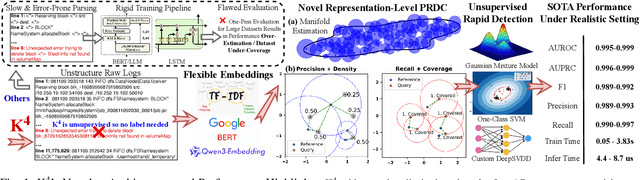
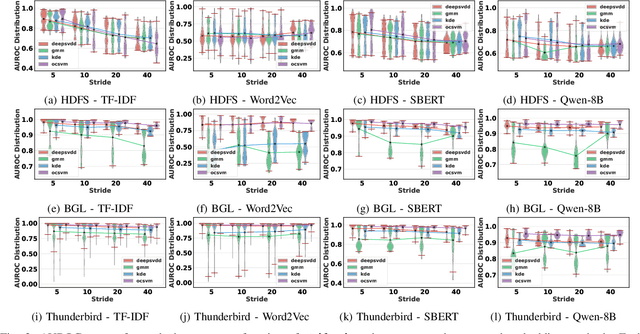
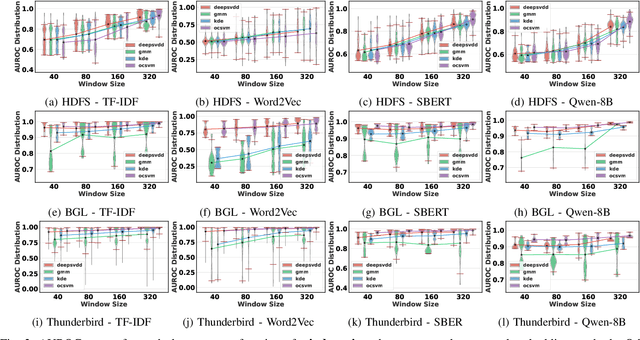
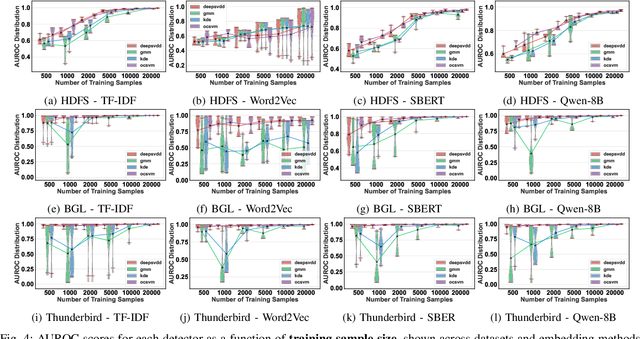
Existing Log Anomaly Detection (LogAD) methods are often slow, dependent on error-prone parsing, and use unrealistic evaluation protocols. We introduce $K^4$, an unsupervised and parser-independent framework for high-performance online detection. $K^4$ transforms arbitrary log embeddings into compact four-dimensional descriptors (Precision, Recall, Density, Coverage) using efficient k-nearest neighbor (k-NN) statistics. These descriptors enable lightweight detectors to accurately score anomalies without retraining. Using a more realistic online evaluation protocol, $K^4$ sets a new state-of-the-art (AUROC: 0.995-0.999), outperforming baselines by large margins while being orders of magnitude faster, with training under 4 seconds and inference as low as 4 $\mu$s.